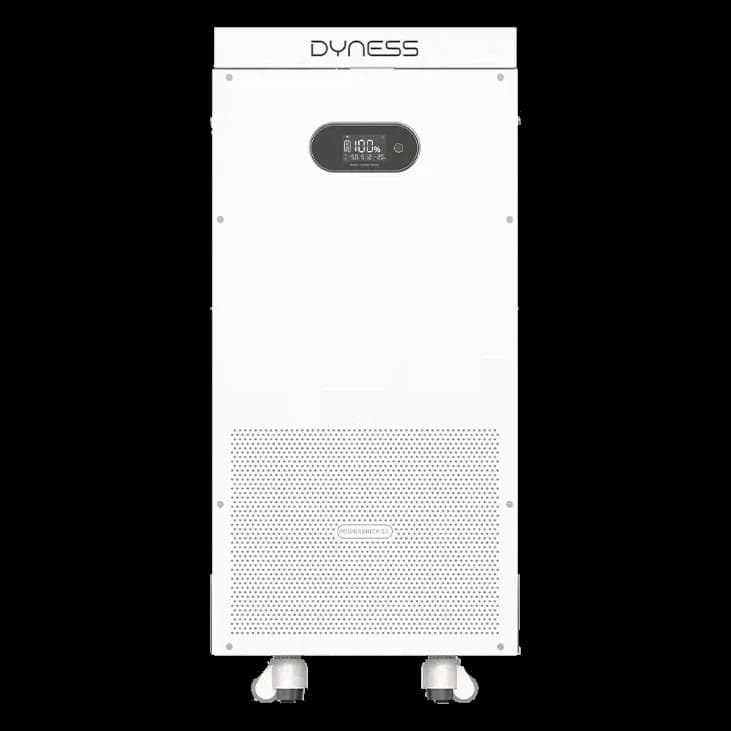
The battery is what keeps solar working at night and through long outages, and it's usually the most expensive part of the system. So it pays to understand a few things before you choose: what's the difference between nominal and usable energy? What do cycles and depth of discharge mean? And how do you look after a battery in Iraq's heat?
Why lithium iron phosphate (LiFePO4)?
LiFePO4 has become the first choice for homes for clear reasons:
- Much longer life: thousands of cycles instead of the few hundred typical of traditional lead-acid batteries.
- More usable energy: you can discharge 80–95% of the capacity without meaningful harm.
- Safe and stable: a more thermally stable chemistry than other lithium types.
- Maintenance-free: no distilled water, no terminal cleaning.
- Smart communication: the battery management system (BMS) talks to the inverter over CAN or RS485 to control charging precisely.
How to read a battery spec sheet
- Nominal energy (kWh): capacity in amp-hours multiplied by voltage. For the Dyness PowerBrick SC: 314 Ah × 51.2 V ≈ 16.08 kWh.
- Usable energy: the part you can actually draw, 15.28 kWh in the same example.
- Depth of discharge (DoD): the share you're allowed to discharge, for example 80% on the 5.12 kWh Deye SE-F5.
- Cycle life: how many charge-discharge cycles until capacity falls to 70%: 6,000+ for Deye SE-F batteries and 8,000+ for the PowerBrick SC.
- Charge and discharge power: the highest power the battery can deliver continuously, which matters when you run big loads at night.
- Protection rating: home batteries are usually IP20 or IP21, meaning indoor installation only.
How much capacity do you need?
Estimate the energy you use between sunset and sunrise, then divide it by the depth of discharge. If you use 8 kWh at night with a battery at 90% DoD, you need at least about 9 kWh, so a 10 kWh battery does the job. If you run an AC at night, night-time use can climb to 15 kWh or more, and a 16 kWh battery becomes the logical choice. Our solar calculator works this out precisely.
One large battery or several small ones?
Modular batteries such as the 5.12 kWh Deye SE-F5 let you start small and expand later, up to 32 units in parallel. Large batteries such as the 16 kWh Dyness PowerBrick SC or Deye SE-F16 pack a lot of capacity into one unit with a simpler installation. Our advice: if you plan to expand, add the new batteries as early as you can, because mixing batteries of different ages or models is generally not recommended.
Check compatibility with your inverter
Every battery in our store is a low-voltage pack with a nominal 51.2 V, designed for 48 V inverters such as the Deye SG05LP1 and OG03. High-voltage batteries need their own matching inverters, and the two types must not be mixed. Also make sure your inverter supports the battery's BMS communication protocol; the Dyness PowerBrick SC, for example, is listed as compatible with Deye, Growatt, Solis, Victron and others.
Safety features
LiFePO4 is one of the safest lithium chemistries, yet some models add extra layers of protection: the Dyness PowerBrick SC has a built-in aerosol fire extinguisher and carries UN38.3 and IEC 62619 safety certifications. In every case, the battery management system protects the cells from over-charging, over-discharging and operating at unsuitable temperatures.
Caring for your battery in Iraq's heat
- Install it indoors, somewhere covered and well ventilated, away from direct sun and water.
- The allowed charging range is usually 0–55 °C, and constant high heat shortens battery life.
- Don't put it on the roof or inside a closed metal box in summer.
- Make sure the BMS communication link to the inverter is connected, and update firmware when the manufacturer releases updates.
- Avoid leaving the battery completely empty for long periods.
What about the warranty?
Battery warranties differ by manufacturer and their warranty letter: the Dyness PowerBrick SC carries 10 years, the Deye SE-F5 5 years or 8 MWh of throughput, and the Deye SE-F16 5 or 10 years depending on the region. Each product page lists the details, and you can compare every option in our lithium batteries section.


